Supplier comparison and sourcing method
Stop Comparing Only Unit Price — The Six Dimensions That Actually Pick the Winner
Every buyer puts Chinese suppliers into a spreadsheet. The first column is almost always unit price. It is usually the wrong first column. Two "identical" quotes for a 5 kW residential inverter can differ by 12–18% in real outcome once you compare the right dimensions — and the cheapest one is rarely the supplier you want.
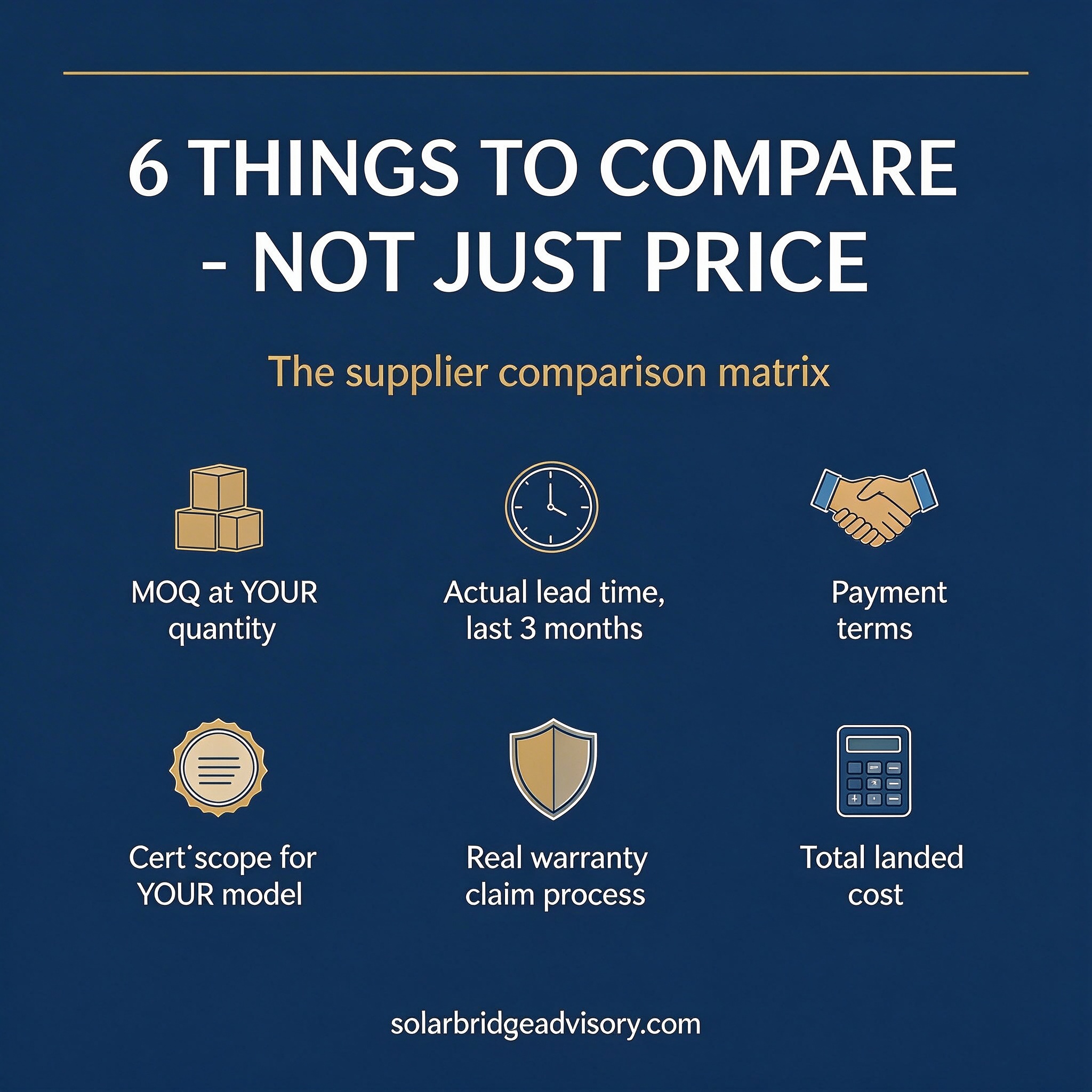
After you define your spec and discover candidates, the compare step should score suppliers on six dimensions, not one:
1. MOQ at your real demand
A supplier offering a strong unit price at 500 units can quietly disqualify you if you need 120. Ask for the price ladder at your actual quantity, not the published headline price.
2. Actual lead time, not the quote
A 25-day lead time in March is not the same as 25 days in September pre-Winter. Ask for the last three months' actual dispatch dates. Calendar-seasonality matters more than the promised number.
3. Payment terms
30/70 T/T, 50/50, deposit against L/C — these shift real cost and risk. A 3% cheaper unit price with 50% upfront can be worse than 1% more with 30/70.
4. Certificate scope fit
A CE or IEC certificate on file is meaningless unless its scope covers your exact model and your destination market. Ask for the certificate number and verify it against the issuing body.
5. Warranty claim process
"5 years" is a number. What actually happens when you file a claim — response time, who pays return freight, are spares stocked near you — is the real warranty.
6. Total landed cost
EXW price, inland freight, port charges, inspection, your duty/VAT, T/T and FX swing. Put this last column in. It usually changes the winner.
Score, don't sort
Score each supplier 1–5 on every dimension on a simple matrix. The supplier that wins the six-dimension matrix is the one who will still be acceptable after the container lands. The one who only wins column one is the one who surprises you six months later.
Use this as a procurement framework, not as engineering, legal, tax or warranty advice. Verify the actual product, route and jurisdiction with qualified professionals.
Continue with SolarBridge
Website: solarbridgeadvisory.com
Fiverr: 1-to-1 China sourcing support
WhatsApp: +86 158 5038 3561
Digital products: View the Guide and Complete Toolkit