Supplier verification
A Video Factory Tour Is Not a Factory Audit — What Buyers Actually Need to Verify
A 30-minute video call through a Chinese supplier's workshop has become the default "factory check." It is useful. It is not a substitute for verification.
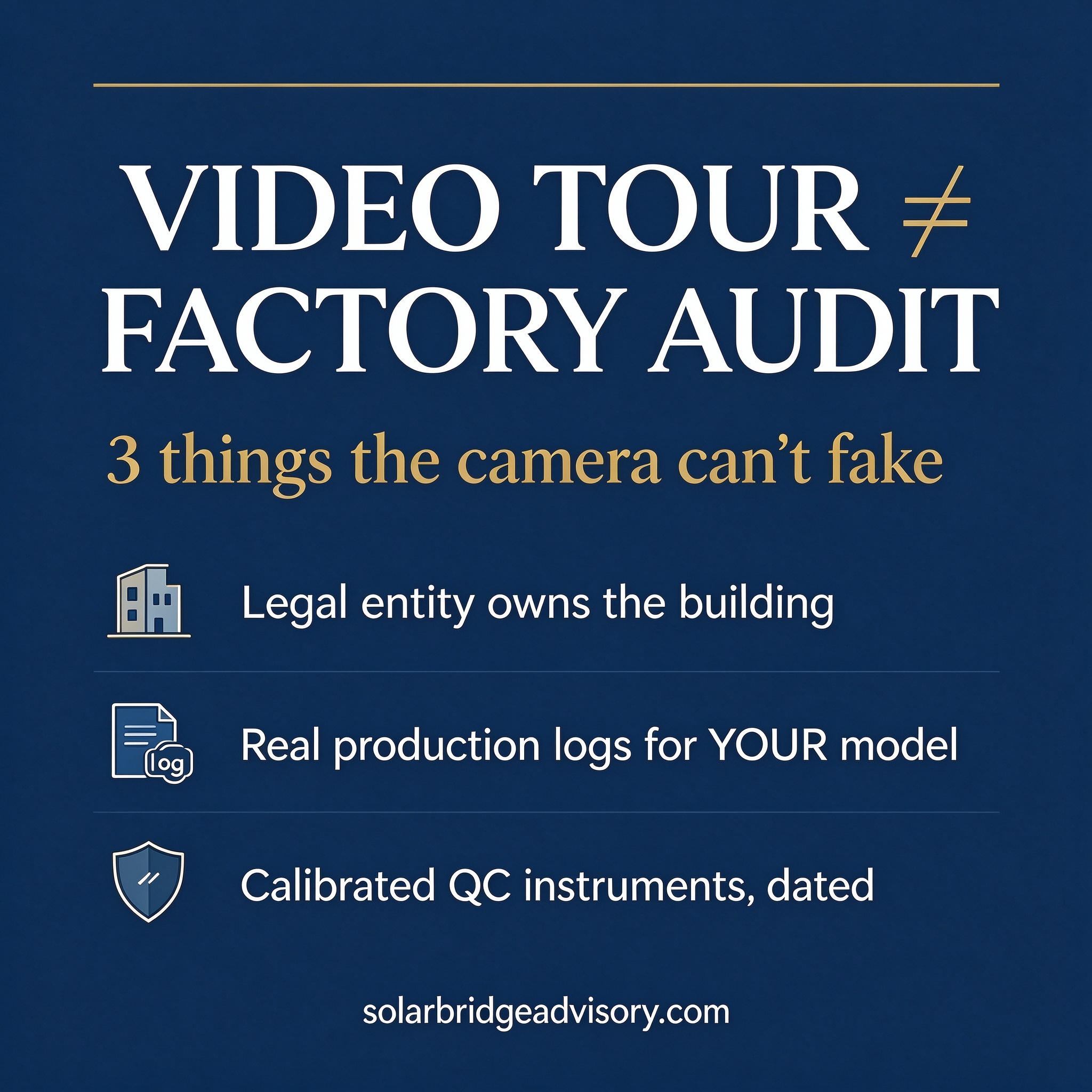
In a video tour, the supplier controls the camera, the route and the timing. You see the clean lines they want you to see. You do not see whether the night shift matches the day shift, whether the equipment on the floor is actually running at your rated capacity, whether the QC room has the instruments your product requires, or whether the legal entity on the quotation even owns that building.
Three evidence points separate a real audit from a show-and-tell
1. Legal-to-physical match. Whose name is on the factory lease, the utility bills and the production-line registration? Many "factories" buyers tour are rented space operated by a different company than the one signing the contract. The quotation entity, the invoice entity and the factory entity should all reconcile.
2. Capacity at your spec, not at brochure spec. Ask for the last three months' production logs for your model — units per shift, yield and the line where they ran. A factory that makes 50,000 units a month of a similar product at a different voltage may not make your batch on time, or to your specification.
3. QC instruments and records, not promises. Calibrated testers, sample retention and outgoing inspection reports — photographed in place, with dates. "We have QC" is not evidence; a dated instrument reading for your product family is.
When the video call is still enough
A video call has real value: it flags obvious fakes fast — empty floors, a sales office pretending to be a plant, or equipment that clearly cannot produce your product. Use it as a first filter, not as the final control.
For orders above the threshold where you could absorb a total loss, a documented third-party audit or a local agent's on-site check is the cheapest insurance you will buy. The cost of verification is small next to the cost of a misdirected container.
Use this as a procurement framework, not as product-specific engineering, legal, regulatory or warranty advice. Verify the actual factory, product and transaction with qualified professionals.
Continue with SolarBridge
Website: solarbridgeadvisory.com
Fiverr: 1-to-1 supplier verification from $299
WhatsApp: +86 158 5038 3561
Digital products: View the Guide and Complete Toolkit